A.I. and Me

Artificial Intelligence has been the talk of most of the literary world for a while, and although it was initially shunned by authors, things have shifted. For instance, a well-known novelist uses it with a few caveats. But it’s not easy for me to embrace A.I. for several reasons:

– Convincing A.I. of my exact writing needs and tone takes too much time. And is it even possible? Those kinds of things come from the heart.
– The author has a sincere understanding, appreciation, and respect of the direction of the work-in-progress. Can A.I. match that?
– A.I can be redundant, something I work very hard not to be. I may not always be successful, but I do my best.

All of this said, my first time using A.I. left me flabbergasted. I found its output amazing! It happened after a long, exhausting day when a friend emailed me. She needed a shoulder to cry on. My shoulders had been dampened quite a bit by this long-suffering friend. Each time, I’d suggested an outcome she wasn’t ready for. Instead of suggesting a similar outcome, I turned to A.I. I specifically summarized what I wanted to say, but asked for greater warmth and understanding. My ask almost sounded like a prayer.

What A.I. created was incredible and uncanny. It was as if I’d written it myself, wholeheartedly. Either my directions were spot on or ??? It was what I would have written with the proper state of mind. Of course, it helped that I’d provided key terms. In the end, I was grateful; it was just what my friend needed to hear.

Even so, I seldom use A.I., but I have the benefit of an A.I. expert in my family who thoroughly enjoys experimenting, especially in creating photos. The photo of me in a tea room with a Woman’s World magazine is A.I. generated, in case you didn’t notice. And here are a few more fun A.I. generated photos of me, courtesy of my dear fam member:

Me, looking like a seasoned P.I. or a hardened criminal. Not sure which.
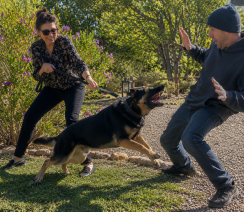
My real dogs are shepherds, but not exactly attack dogs.
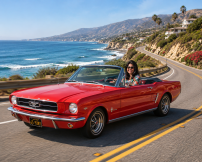
I once drove a red Mustang and voila! I’m driving one again! Do I look too big for the car?

Writing a Standout Author Bio

Some author bios just have me reeling in admiration. Not so much because of the content, but because of the way the content is presented. The best ones carry a unique, personal voice, and just enough relevant background information. A bit of humor can be a plus.

Take note of the typical elements in an author bio:

– Name
– Profession
– Genre
– Awards, recognitions
– Relevant expertise
– Location
– Personal detail(s)

Here are two examples:

Mary Walker is the author of seven published books. She lives in California’s San Fernando Valley with her husband of 32 years, Sam, and a mischievous Siamese cat named Katra.

Name: Yes
Profession: No
Genre: No
Recognition: No
Relevant expertise: No
Personal detail: Yes

Would it be more interesting to know a little bit more about Mary? She could be a VERY interesting person with lots of interesting stories. But we don’t know that. Is she just being modest? Maybe. What genre are her books? What’s her background? I think you’d agree there should be something more to make it memorable. Why should we bother with the other elements? Check out this author bio:

Tiffany D. Jackson is the critically acclaimed author of Allegedly, Monday’s Not Coming, and Let Me Hear a Rhyme. A Walter Dean Myers Honor Book and Coretta Scott King–John Steptoe New Talent Award winner, she received her bachelor of arts in film from Howard University, earned her master of arts in media studies from the New School, and has over a decade in TV and film experience. The Brooklyn native still resides in the borough she loves. You can visit her at www.writeinbk.com.

My favorite bios are short and sweet, which is an invitation for me to read and appreciate every word, and that’s what I did with the second one. It includes the author’s background, recognitions, and personal detail. The titles are intriguing and an important inclusion. Plus, her website link directs the reader to visit to learn more about her and her books. See the difference a few words can make?

Writing Resilience - Moving On!

Have you ever been rejected or hurt or offended or experienced a negative emotion that’s a challenge to shake off? For writers, being of a sensitive nature, this can be problematic. But writers are also risk takers. Every time they write a story sharing their personal visions and imagination and then set it loose in the world, they are demonstrating courage, which is needed to exercise resilience.

But there are times when we feel overwhelmed by negation. How to bounce back quickly and move on?

1. Never allow discouragement in. It stifles our desire to make that greater effort, and it limits our potential. Replace discouragement with courage and lots of faith. Ever hear of bestselling author Debbie Macomber? She wasn’t an overnight sensation, but she is a great and talented success.

2. Face your rejection. Okay, so someone wasn’t keen on your manuscript. If criticism was offered, learn from it and move on. It just takes a little practice to learn to move on. Keep writing. Every time you do, it brings you closer to your goal of publication.

3. Don’t be attached to the outcome. Very Zen-like, don’t you think? I have a manuscript or two that has yet to be published. What if they’re never published? When I ask myself if I enjoyed writing them, the answer is a resounding yes! Which means, that whether they’re published or not, they were worthwhile to me. Keep your perspective and you’ll be exercising resilience.

4. Practice Optimism. This is where social support can be helpful. Reach out to other writers who understand the importance of bouncing back. Or to anyone who’s faced a challenge and overcome it. Fan your good attitude so that you keep your fire of passion for your craft thriving.

5. Nurture your sense of humor.

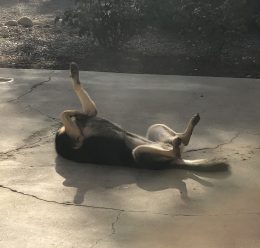
This is not a headless dog. This is Willow in her favorite position. Did the picture make you smile?
Laughter is not only the best medicine, it’s a game changer. If you can laugh at a negative situation, it diffuses the unpleasant impact, allowing you to let go more quickly and do what we need to do. Move on!